
How Flexible Loads Are Reshaping the Energy Market
The Six Core Opportunities for Bitcoin Mining

Bitcoin mining has long been characterised as an energy-intensive industry with a straightforward economic model: buy cheap electricity, convert it into hash rate, earn block rewards. But mining operations are increasingly becoming active participants in electricity markets. Not just as consumers of power, but providers of a service that modern grids urgently need. That service is flexibility.
What Is a Flexible Load?
Why Grids Need Flexibility Now
The Six Core Opportunities
Demand Response Programs
Capacity Markets
Manual Frequency Restoration Reserve (mFRR)
Curtailment Programs
Energy Arbitrage
Behind-the-Meter Power Purchase Agreements
Stacking the Revenue Streams - Premium Insights
A New Role in the Energy Transition - Premium Insights
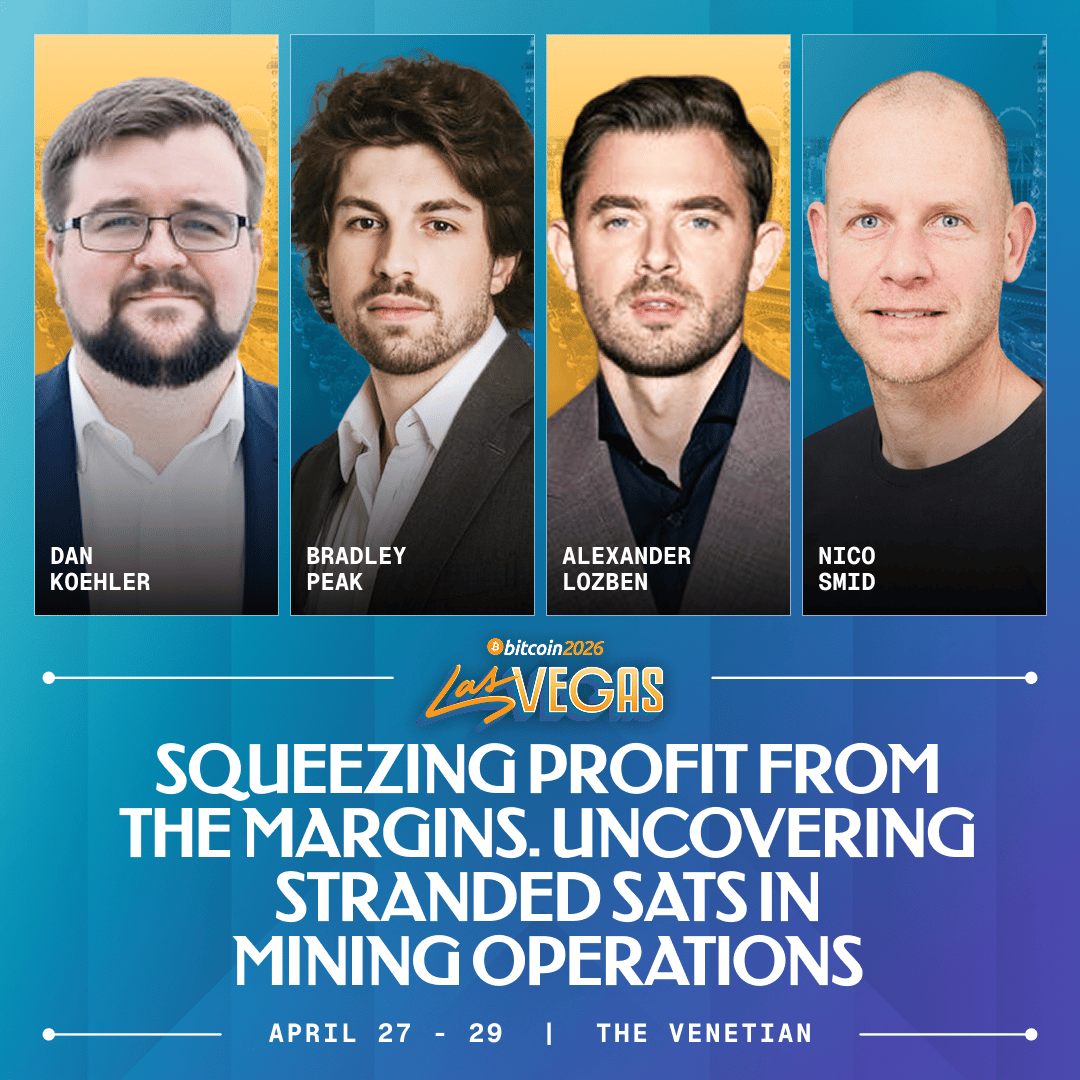
I’m excited to be moderating a panel at The Bitcoin Conference 2026 in Las Vegas, one that goes straight to the core of mining profitability. The session, “Squeezing Profit from the Margins: Uncovering Stranded Sats in Mining Operations,” will take place on Wednesday at the Energy Stage.
Hope to see you there. If you’d like to meet in person, just reply to this email or book a meeting through the conference app.
What Is a Flexible Load?
A flexible load is an electricity consumer that can adjust its power consumption in response to grid signals, electricity prices, or operational needs. Unlike a continuous industrial process or a latency-sensitive workload, Bitcoin mining can curtail or expand power draw in seconds without disrupting the network.
Bitcoin mining is exceptionally well-suited to this role. Individual ASIC machines can be powered down and back up almost instantly, allowing an operator to shed or restore megawatts of load within minutes. This near-instant response capability is rare among industrial consumers and is precisely what electricity grids need as they absorb more variable renewable generation.
Other flexible load candidates like electric vehicle charging infrastructure or AI compute clusters, share some of these characteristics, but none match the speed of curtailability of a mining fleet. That technical edge is translating into a genuine economic advantage.
Why Grids Need Flexibility Now
Electricity grids must maintain a constant balance between generation and consumption. Even small imbalances cause frequency deviations; large ones can trigger cascading outages. Traditionally, grid operators managed this balance by dispatching gas peaker plants or hydro reserves on short notice.
The rapid expansion of wind and solar generation has made this balancing act harder. Renewable output is inherently variable, a cloud bank or a lack of wind can remove gigawatts of supply in minutes. Conventional plants are being retired faster than dispatchable replacements are being built. The result is that grid operators worldwide are increasingly turning to demand-side flexibility. Large consumers that can reduce or shift their load on request, effectively acting as virtual power plants in reverse. For Bitcoin miners, this structural shift in energy markets is creating revenue opportunities that sit entirely outside the Bitcoin price cycle.
The Six Core Opportunities
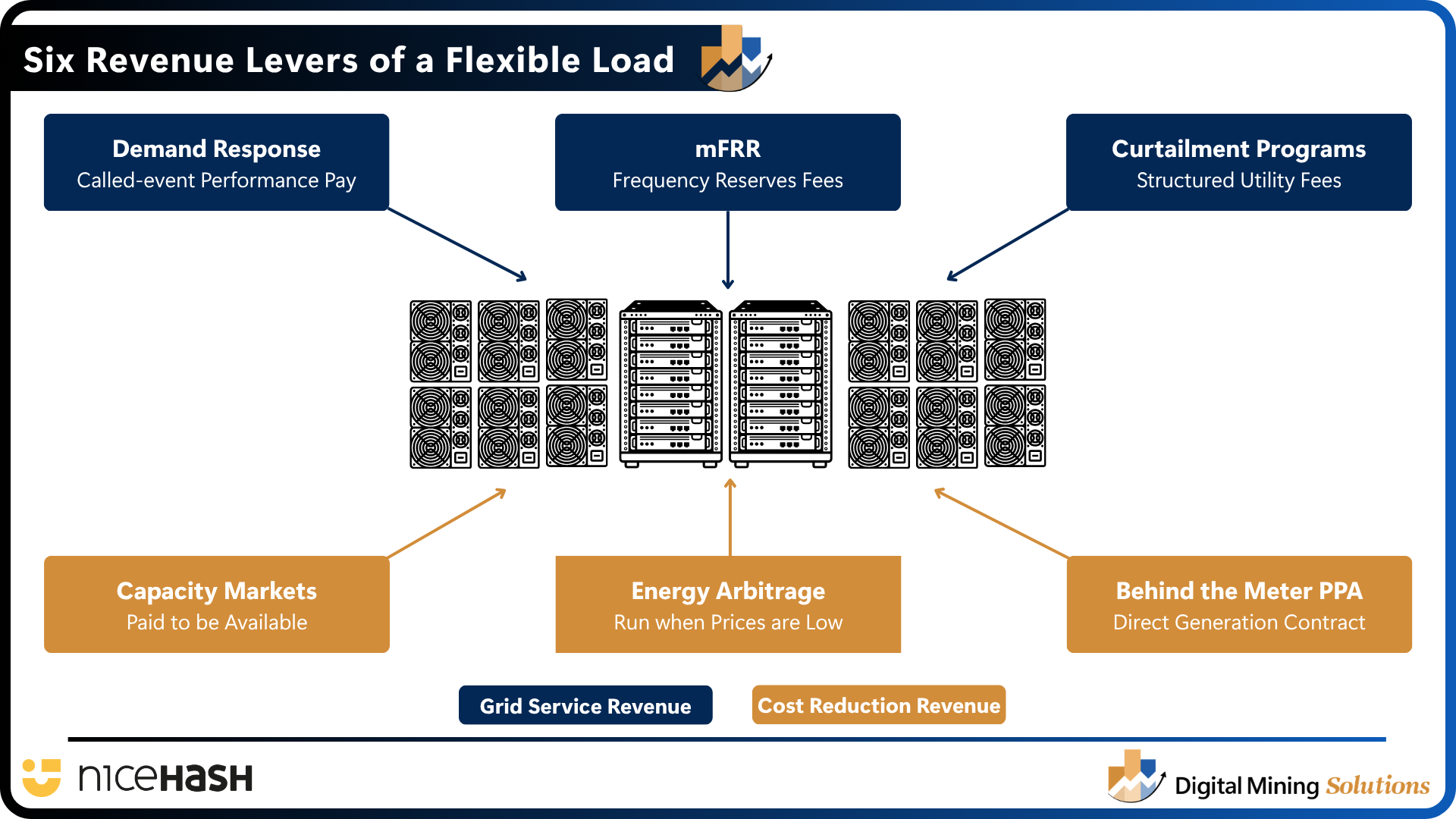
Grid flexibility unlocks revenue across six distinct mechanisms each with different trigger conditions, payment structures, and infrastructure requirements. Understanding how they work individually is the foundation for knowing how to stack them effectively.
1. Demand Response Programs
The most widely available mechanism, demand response programs allow grid operators or utilities to request temporary load reductions during periods of peak stress like extreme weather, unexpected plant outages, or transmission congestion.
Miners enrolled in demand response receive compensation through availability payments (paid simply for being enrolled and ready), activation payments (paid when a curtailment event is actually called), or both. In markets like ERCOT in Texas and PJM in the north-eastern United States, demand response has become a well-established revenue stream for large industrial loads. European grid systems offer equivalent programmes under various names.
Demand response is pay-per-use. You register with a utility or aggregator, and when a stress event occurs (a heat wave, an unexpected plant trip, transmission congestion), the operator sends a signal and you reduce load. You get paid per megawatt-hour you actually shed during that window.
2. Capacity Markets
Where demand response pays for performance, capacity markets pay for availability. Grid operators in many markets hold forward auctions to secure a reserve of load that can be called upon during future stress periods. Participants are paid a fixed monthly fee simply for enrolling and committing to be available. Capacity markets are essentially an insurance contract the grid buys from you.
PJM’s capacity market, for instance, clears three years ahead of the delivery period. For a mining operation, this creates a predictable, baseload revenue stream that is largely independent of whether any curtailment events actually occur. You may never actually be called to curtail. The payment is for the option, not the exercise of it. The trade-off is commitment: if called and unable to perform, operators face payment clawbacks and potential penalties.
Capacity payments are particularly valuable for project finance and operational planning, as they appear as near-certain future income on a pro forma. Sophisticated operators often stack capacity market enrolment with demand response participation the capacity payment provides stable income, while demand response events generate upside when they occur.
The practical difference between demand response and capacity markets for a miner comes down to revenue predictability vs revenue upside. Capacity payments are stable and foreseeable, demand response payments are variable but can be very high per event, especially in tight grid conditions where prices spike.
3. Manual Frequency Restoration Reserve (mFRR)
Prominent in European electricity markets, Manual Frequency Restoration Reserve (mFRR) is a balancing service used by grid operators to restore system frequency after an imbalance event. Participants offer either upward flexibility (increasing consumption when there is excess generation) or downward flexibility (reducing consumption when demand outstrips supply).
Participation in European mFRR markets often occurs through aggregators, which bundle multiple flexible loads into a single resource large enough to meet minimum bid volumes. For smaller mining operations, aggregators provide a practical route into balancing markets that would otherwise require scale they do not individually possess.
mFRR compensation typically includes both capacity payments for standing ready and activation payments when the service is actually called. In markets with significant renewable penetration like Germany, the Nordic countries, and the Iberian peninsula, mFRR events are becoming more frequent, increasing the activation revenue available to participants.
4. Curtailment Programs
Curtailment programs arise in regions with high concentrations of renewable generation, particularly wind and hydro. When supply significantly exceeds demand for example during spring snowmelt, or in wind-rich regions during overnight low-demand periods, grid operators may need consumers to absorb surplus power or simply reduce consumption to prevent network congestion.
Mining operations located near renewable generation sites are well-positioned to negotiate curtailment agreements directly with generators or utilities. In exchange for agreeing to reduce operations when required, miners typically receive significantly below-market electricity prices during normal operating hours.
Stranded natural gas sites, where associated gas cannot be economically transported to market represent a related opportunity. Operators deploying mobile mining infrastructure at these sites access very cheap or effectively free energy, while providing a useful load that reduces flaring.
5. Energy Arbitrage
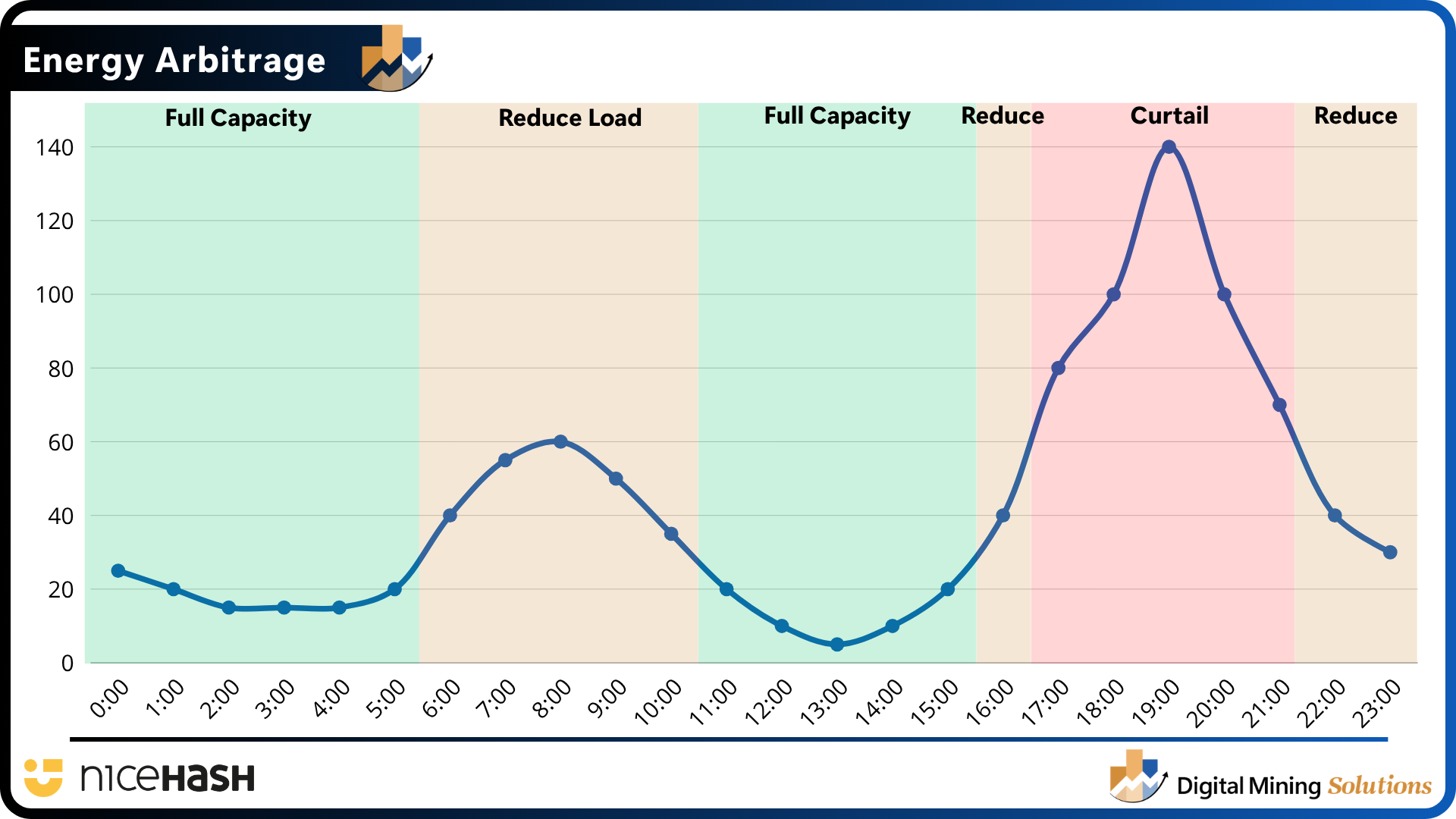
Flexible loads can extract value from price volatility without formal programme enrolment. In markets with real-time or hourly pricing, electricity prices can swing from near zero to several hundred dollars per megawatt-hour within a single day. Operators with the data infrastructure to monitor market prices can run at full capacity during low-price windows and curtail during spikes.
This approach is particularly effective in markets with high renewable penetration, where cheap midday solar and expensive evening peaks, creates predictable daily arbitrage windows. Over a year, a miner actively managing consumption against price signals can materially reduce their average all-in electricity cost compared to a flat-rate consumer.
Energy arbitrage requires no formal enrolment or contract, but it does require real-time metering, automated control systems, and a willingness to accept intermittent downtime in exchange for lower average energy costs.
6. Behind-the-Meter Power Purchase Agreements
Behind-the-meter arrangements involve co-locating a mining operation directly with a generation asset and contracting for power before it reaches the public grid. This structure allows miners to avoid transmission and distribution charges (which in some jurisdictions can account for a significant portion of the delivered electricity cost) and to negotiate pricing directly with the generator.
For renewable developers, a co-located mining load provides a guaranteed off-taker that can absorb generation that might otherwise be curtailed, improving project economics and reducing merchant risk. For miners, the arrangement provides access to some of the cheapest available electricity, in exchange for accepting that supply may be intermittent when generation is low.
The operators pulling ahead aren't just chasing cheap power — they're stacking multiple revenue streams from the same physical load, turning a warehouse of ASICs into a mining operation, a grid balancing resource, and an energy hedge simultaneously. Understanding how to structure that is becoming a core competitive advantage. Upgrade to premium to read the full breakdown.

Leverage data-driven insights and a powerful network to launch strong, optimize efficiently, and scale with confidence. We offer:
Market Intelligence - Masterclasses, Tailored Reports & Articles and Industry Benchmarks.
Advisory Services - Business Plan Assessment, Investor Presentations, M&A Advisory and Executive Coaching.
Sites & Rackspace - Due Diligence & Partnership Matchmaking, Institutional Investment Guidance and Rackspace Sales
Elevate your mining operation today with Digital Mining Solutions!
If you enjoy the content, if you have not subscribed, please ensure to click the button below and share The Bitcoin Mining Block Post.
If you want to stay ahead in the world of Bitcoin mining, make sure to follow me on Twitter and LinkedIn. Would you like to become a sponsor of the newsletter or are you interested in a workshop on mining economics? Contact me at nicosmid@digitalminingsolutions.tech.