
The 2026 Hashrate Contraction
Here's what the data says, what comes next, and who is winning

For years, Bitcoin’s hashrate followed one dominant direction: up. Even through bear markets, tightening margins, and post-halving pressure, the network kept expanding as miners relentlessly deployed new machines and additional power capacity. But 2026 is beginning to look different. For the first time since the China mining ban, the network is experiencing a sustained structural contraction. Behind the slowdown is a much larger shift taking place across global infrastructure markets. AI and HPC are competing directly with Bitcoin mining for power, capital, and data center capacity, and increasingly, they are winning. The result is reshaping not only the mining industry, but the economics of compute infrastructure itself.
Hashrate Down +100 EH/s YTD
The Numbers in Context
Compute Is Migrating and Bitcoin Feels It
The Industry Is Reallocating Infrastructure
AI’s Power Hunger Is Reshaping the Energy Landscape
The Few Miners Still Betting Big on Bitcoin Expansion
Scenarios for the Rest of 2026 - Premium Content
Shrinking Hashrate Benefits Surviving Miners - Premium Content
Hashrate Down +100 EH/s YTD
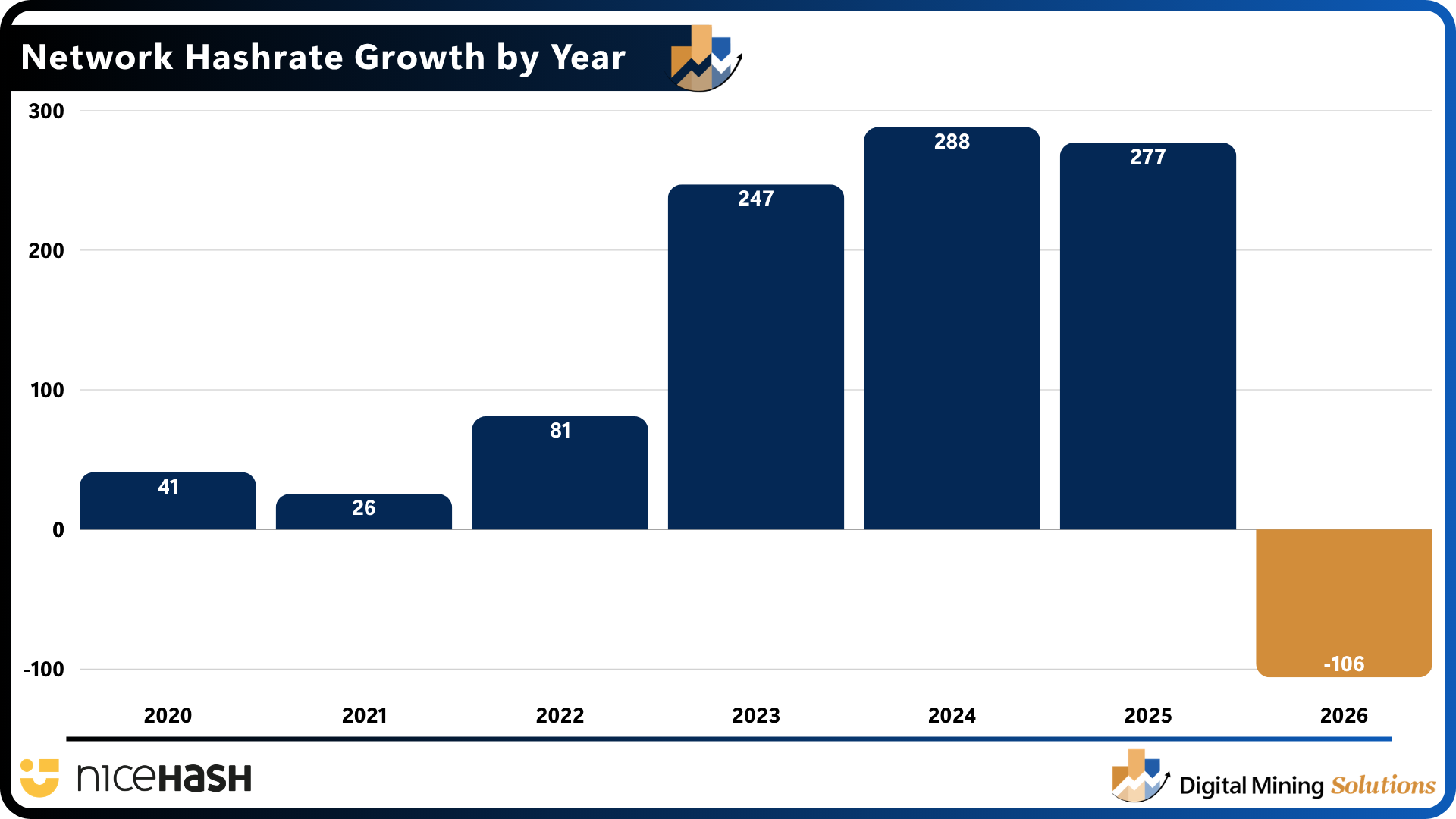
For the first time in over five years, Bitcoin’s hashrate is contracting structurally. Not a blip, not a bad week but a sustained, measurable decline that has persisted through the first four months of 2026. As of May 12th, the network’s 7-day moving average sits at approximately 964 EH/s, down from 1,070 EH/s at the start of the year. That’s roughly 106 EH/s wiped off the network in 132 days. This -10% drawdown that puts 2026 on track to post negative hashrate growth in H1 for the first time since the China mining ban rattled the network in 2021.
To understand how unusual this is, consider the trajectory. The network added 41 EH/s in 2020, 26 EH/s in 2021, 81 EH/s in 2022, and then exploded adding 247 EH/s in 2023 and 288 EH/s in 2024. Even 2025, a year of tightening margins, added 278 EH/s net. The network kept growing relentlessly, until now.
The Numbers in Context
The -4% year-on-year decline understates the speed of the contraction. On a year-to-date basis, the network has already lost nearly as much hashrate in four months as it added during 2021 and 2022 combined.
More importantly, the decline has been persistent rather than episodic. Since early January, the 7-day moving average has been trending downward with only brief interruptions, pointing to a broader structural slowdown rather than a short-term shock.
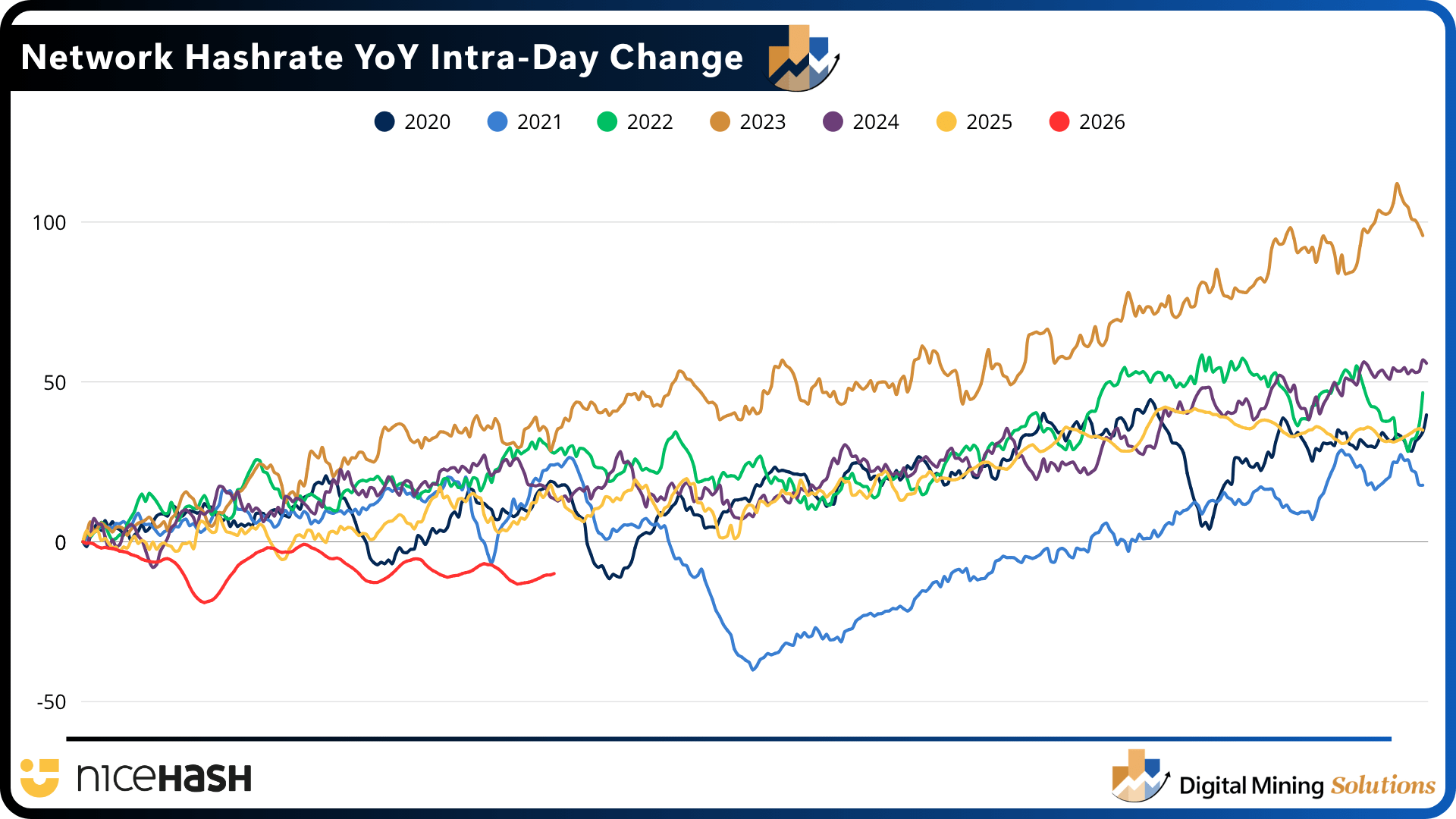
What makes this moment distinct from 2021’s China-driven crash is the cause. In mid-2021, hashrate collapsed nearly 40% within weeks because a regulatory hammer forced miners offline overnight. Recovery was swift once those machines found new homes, mostly in the US. The 2026 contraction is slower and more deliberate. Capacity isn’t going offline in an emergency but it’s being redirected by design. That distinction matters enormously for how we think about recovery timelines.
Compute Is Migrating and Bitcoin Feels It
Bitcoin is still trading roughly $20,000 above this cycle’s low, and because this downturn has been relatively shallow compared to previous bear markets, the industry has largely avoided the wave of bankruptcies, forced liquidations, and distressed M&A activity that defined earlier cycles. But the most important force behind 2026’s hashrate contraction is not simply market weakness. It is capital allocation.
According to Crunchbase, venture capital invested roughly $242 billion into artificial intelligence during the opening months of 2026, representing nearly 80% of total VC deployment. At the same time, hyperscalers are signing decade-long power agreements, while GPU infrastructure continues to command premium lease rates.
This is changing how mining operators view their businesses. Increasingly, companies are realizing that their most valuable asset is not the ASIC fleet itself, but the power capacity, land, and infrastructure underneath it. As a result, a growing number of miners are reallocating capital toward AI and HPC buildouts where returns per megawatt are often more stable and economically attractive than Bitcoin mining at current hashprice levels. The effect is now becoming visible across the industry.
The Industry Is Reallocating Infrastructure
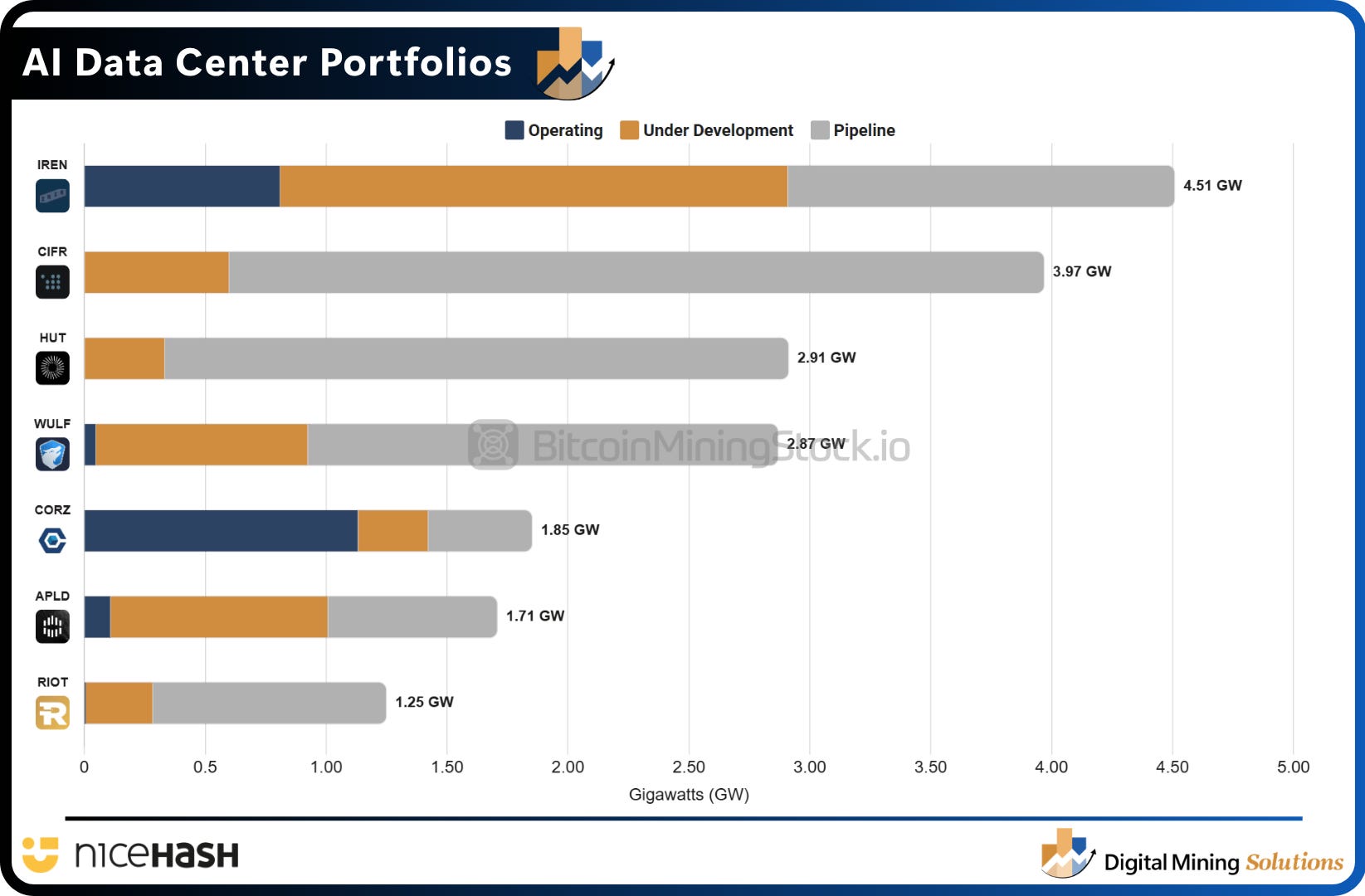
Several publicly listed miners have already begun redirecting infrastructure and capital toward AI and HPC deployments.
IREN is actively converting mining infrastructure from ASICs to GPU compute, recording $140.4 million in non-cash impairments tied largely to retired mining hardware. Hut 8 is repurposing its Beacon Point mining campus into an AI data center built around NVIDIA’s DSX architecture under a reported 15-year, $9.8 billion lease agreement.
TeraWulf expanded its power portfolio to 2.8 GW through acquisitions aimed at AI and HPC development, while Digi Power X shut down mining operations at its Alabama facility to convert the site into a Tier 3 AI infrastructure hub.
Cango sold 4,451 BTC for $305 million in February 2026, with plans to use proceeds to reduce leverage and pivot into AI computing infrastructure. Active reversal of mining focus. And Cipher is essentially the poster child for the pivot: renamed, sold its ASIC-heavy JV, stopped mining at its main site, and is now building AI/HPC colocation infrastructure with institutional-grade financing.
The result is increasingly visible in the network data itself. Infrastructure that was originally built to secure Bitcoin is now being repurposed, converted, or temporarily idled as operators reposition toward higher-value compute workloads.
AI’s Power Hunger Is Reshaping the Energy Landscape
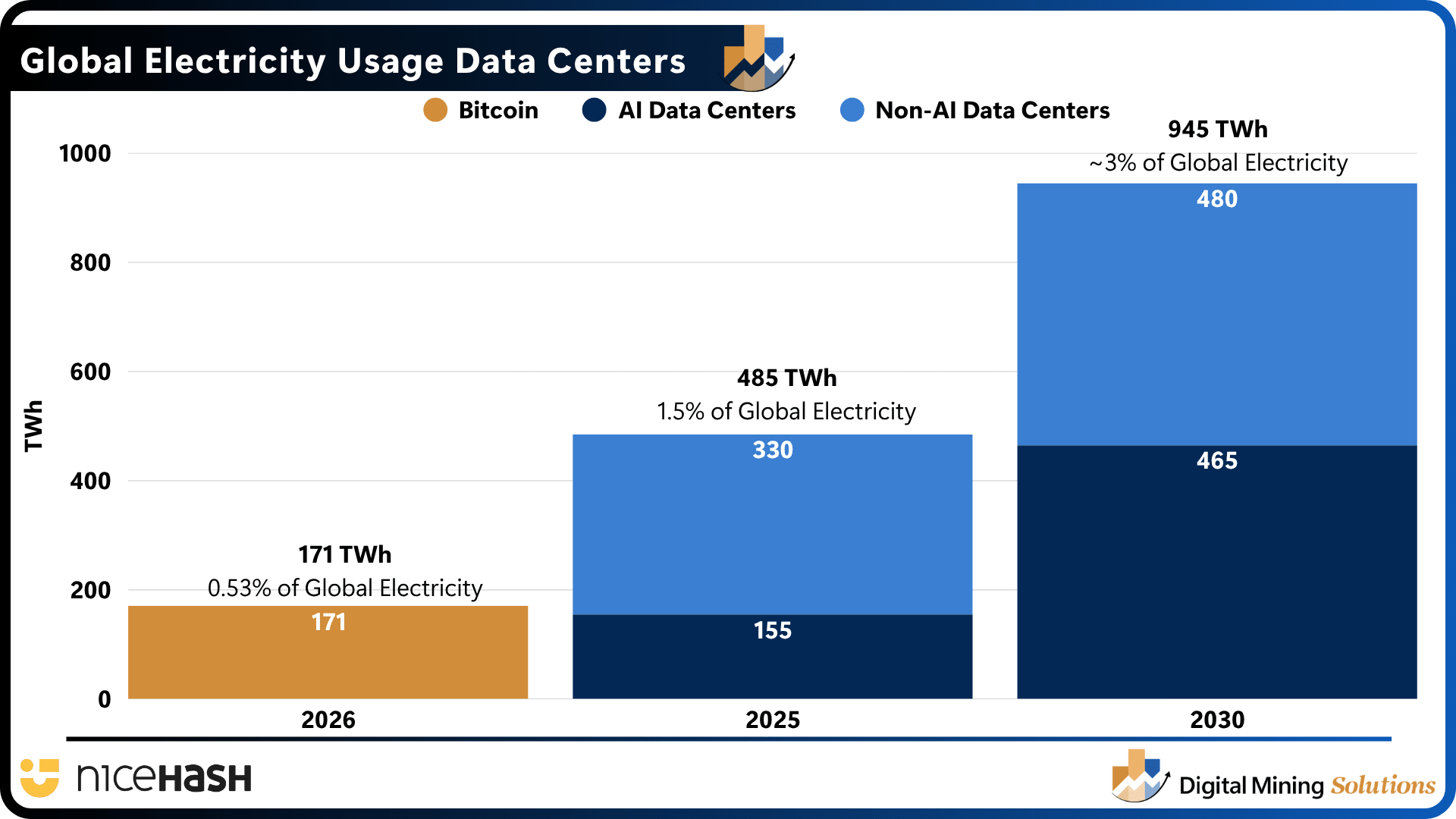
When comparing global electricity consumption, AI data centers are now approaching the scale of the entire Bitcoin network. According to the International Energy Agency, AI-focused data centers consumed approximately 155 TWh of electricity in 2025, representing around 0.5% of global electricity demand. That is already very close to the estimated electricity consumption of the Bitcoin network as a whole.
When including all data centers (not just AI-related facilities) total electricity consumption is now nearly three times higher than that of Bitcoin mining. More importantly, this trend is accelerating. The IEA expects global data center electricity demand to nearly double to 945 TWh by 2030.
AI infrastructure is expected to be the primary driver behind this growth. By 2030, AI data centers alone are projected to consume roughly 2.7 times more electricity than the entire Bitcoin mining industry consumes today. This suggests that competition for power is unlikely to ease anytime soon. Over the next five years, Bitcoin miners will continue competing with AI and HPC infrastructure for access to energy, grid capacity, and power contracts.
The Few Miners Still Betting Big on Bitcoin Expansion
That does not mean expansion in Bitcoin mining has completely stopped. A small number of public miners are still deploying meaningful new capacity. But importantly, these cases increasingly stand out as exceptions rather than the industry norm.
The clearest example is American Bitcoin. On March 3, 2026, the company announced the purchase of 11,298 new Bitcoin miners, adding roughly 3.05 EH/s of capacity at approximately 13.5 J/TH efficiency. The deployment expanded its fleet to 89,242 miners and 28.1 EH/s of total hashrate, with the energization of the Drumheller site completed on April 22.
What makes this notable is not just the scale of the deployment, but the strategic direction behind it. While many peers are reallocating infrastructure toward AI and HPC, American Bitcoin has explicitly doubled down on Bitcoin mining. Management has framed the strategy around maximizing long-term Bitcoin accumulation and even reactivated a previously shuttered Hut 8 site to deploy the new fleet.
Bitdeer represents a different type of expansion story. The company’s self-mining hashrate reached approximately 70 EH/s by March 2026, up more than 500% year over year, driven primarily by deployment of its internally manufactured SEALMINER hardware. Unlike most miners, Bitdeer is less dependent on external ASIC suppliers such as Bitmain or MicroBT, giving it greater flexibility to continue scaling even during a period of broader industry caution. At the same time, the company has been retiring older third-party machines, making this both a fleet modernization and expansion cycle.
Canaan falls somewhere in between. In February 2026, the company acquired Cipher Mining’s 49% stake in a West Texas joint venture and, as part of the transaction, also acquired 6,840 Avalon A15 Pro miners. While the hardware purchase was tied to the broader JV acquisition rather than a standalone expansion order, it still resulted in incremental growth of Canaan’s self-mining fleet.
Taken together, these examples show that growth has not disappeared entirely from the sector. But compared to previous cycles, aggressive ASIC deployment is now concentrated among a much smaller group of operators, while the broader industry increasingly prioritizes AI infrastructure, power monetization, and higher-value compute workloads.
In the premium section, we break down the select group of public miners still aggressively expanding Bitcoin capacity, outline three realistic scenarios for the network through the rest of 2026, and explain why a declining hashrate may become a major tailwind for the operators that survive. If you want to understand where mining economics, infrastructure allocation, and competitive positioning are heading next, this is the section you do not want to miss.
Cango Continuing Strategic Fleet Modernization and Enhancing Production Efficiency
MARA, Block, Foundry, and others join Stratum V2 working group
Soluna Holdings Closes $53M Wind Farm Acquisition and Reports Operational Progress
Canaan Inc. Extends Collaboration with Tether on New Form Factors for Mining and Compute Systems

You don't lose money because the model was wrong. You lose money because reality doesn't follow the model. Execution risk is the variable most investors underestimate and the one we specialise in. Book a call today and let's pressure-test the plan.
If you enjoy the content, if you have not subscribed, please ensure to click the button below and share The Bitcoin Mining Block Post.
If you want to stay ahead in the world of Bitcoin mining, make sure to follow me on Twitter and LinkedIn. Would you like to become a sponsor of the newsletter or are you interested in a workshop on mining economics? Contact me at nicosmid@digitalminingsolutions.tech.