
Why Cooling Optimization Now Matters More Than Chip Efficiency
NVIDIA's next platform gets 40% more GPUs from the same power budget by optimizing cooling, not silicon

Every advance in AI compute creates a corresponding challenge: heat. Frontier training racks now exceed 100 kW, inference racks are already running at 370 kW, and NVIDIA’s next generation is specified at 600. These densities call for a different cooling standard than air was built around, and the operators who treat cooling as a qualification filter, not a spec sheet line item, are the ones who scale. It is not only about how much power a site has, it’s about what it does with the heat the compute creates.
Rack Density Doubles Every Generation
Where Air Cooling Hits Its Ceiling
Cooling Becomes a Qualification Filter
The Water Question Liquid Cooling Doesn’t Solve
Compact Footprint Hybrid Architecture

FBOX’s 1.25MW and 10MW AI data center solutions combine direct-to-chip liquid cooling with hybrid air-side cooling systems to meet the thermal demands of modern AI and HPC workloads. Designed for rack densities exceeding 150kW, FBOX delivers efficient, reliable cooling infrastructure built for high-density compute environments.
Rack Density Doubles Every Generation
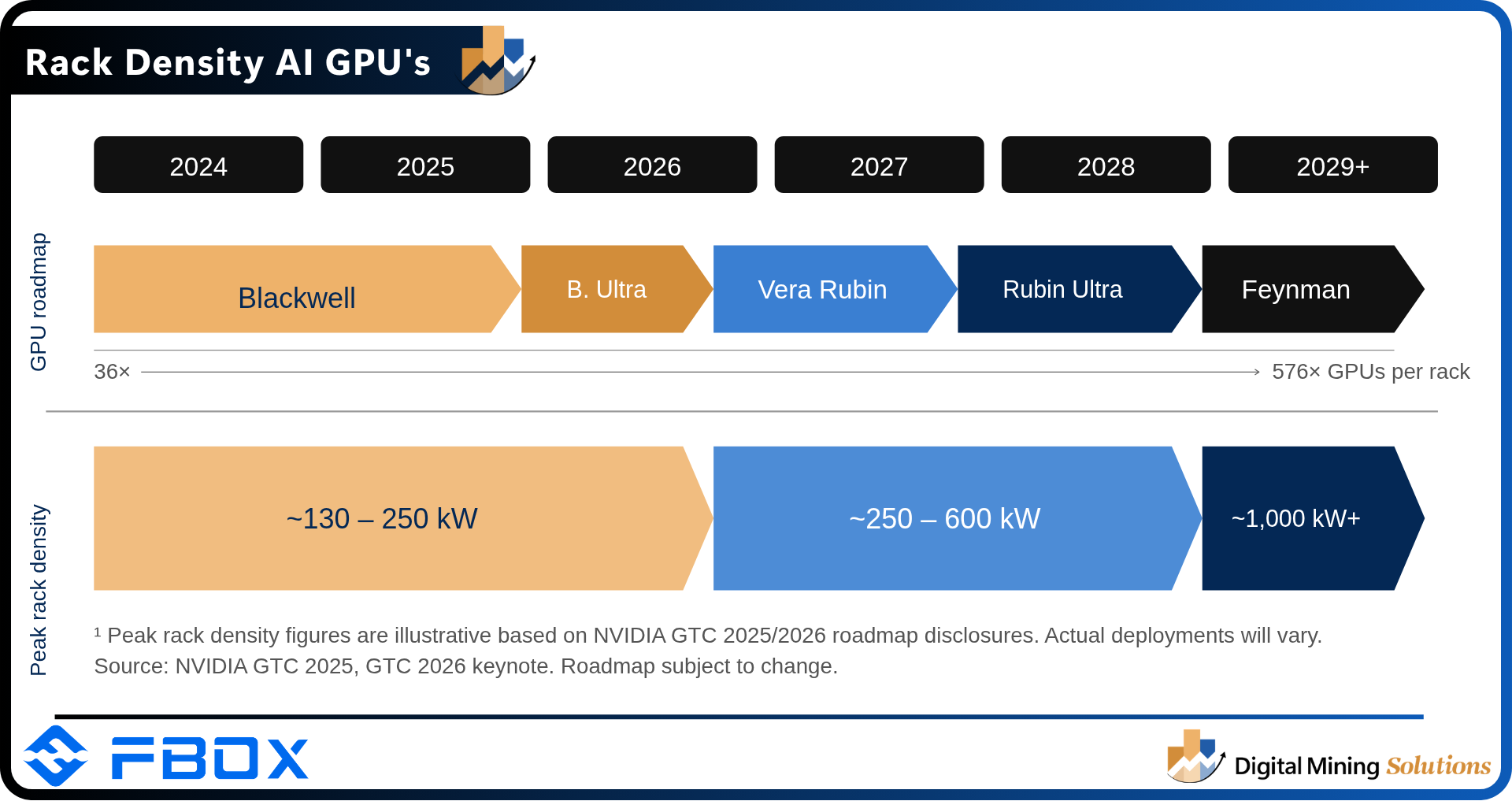
Frontier training racks now exceed 100 kW. Inference-optimized racks from leading GPU suppliers are already running at 370 kW, nearly three times the density of the training version of the same hardware. NVIDIA’s next-generation Rubin Ultra Kyber rack, due in the second half of 2027, is specified at 600 kW.
Rack power is roughly doubling with each hardware generation, from Blackwell through Feynman. A facility built to exactly today’s density spec is obsolete before its next refresh cycle, and operators designing for current requirements rather than the next generation are building the wrong facility on purpose.
NVIDIA isn’t just pushing density; it’s pairing every generation with cooling engineering to match. The company’s newest rack-level cooling platform, announced at GTC Taipei in May 2026, pairs 45°C liquid cooling with in-rack power optimization to support up to 40% more GPUs within the same power budget. Efficiency gains are increasingly coming from the cooling loop itself, not just the chip.
Where Air Cooling Hits Its Ceiling
For decades, air cooling handled data center workloads fine. Better airflow management, containment design, and precision cooling technology let facilities support steadily increasing compute densities without sacrificing reliability.
AI broke that pattern. Across the industry, rack densities in the 40–60 kW range are widely regarded as the point where conventional air-cooling architecture hits its practical limit. Beyond that, both cooling performance and operating efficiency favour liquid-assisted solutions.
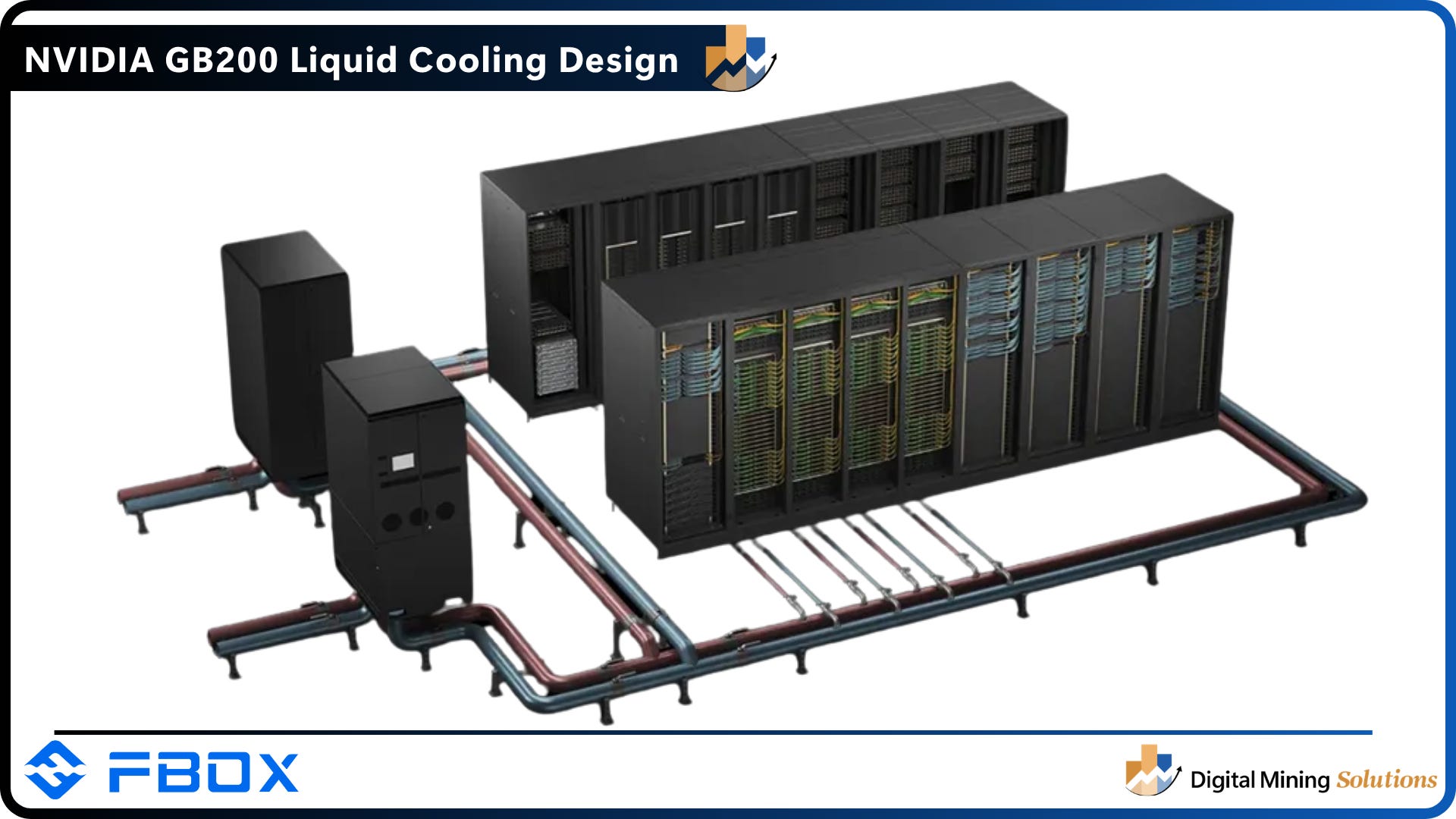
Direct-to-chip cold plate liquid cooling has emerged as the preferred approach for modern AI environments because it removes heat directly at the source, the CPU and GPU package, where thermal loads are highest. Transferring heat at the source supports significantly higher rack densities and reduces the load on air-side systems. The shift is being driven by rack power density, not marketing.
Cooling Becomes a Qualification Filter
GPU server packages aren’t Bitcoin mining ASICs. They concentrate substantially more heat per rack, and the standard they’re held to is different: a tenant signing a colocation agreement expects N+1 redundancy, continuous monitoring, and maintenance procedures they can audit, not a facility that merely keeps hardware from throttling. A cooling design with no credible, phased path to GPU-grade density is a disqualifier, not a future upgrade.
That standard increasingly gets set before groundbreaking, by the reference architecture a prospective tenant builds to. NVIDIA’s Enterprise Reference Architecture, the most widely deployed program, specifies rack power, cooling type, floor loading, and network fabric across three tiers mapped to workload. A tenant doesn’t lease generic “GPU space”, they lease capacity that conforms to the architecture their workload was certified on, and they audit against it. Knowing which reference design a prospective customer targets tells an operator the cooling spec to build to before the first procurement conversation, not after.
The Water Question Liquid Cooling Doesn’t Solve
The transition isn’t driven by thermal performance alone. As AI infrastructure expands into water-constrained regions and larger compute campuses, operators are weighing cooling architecture across several dimensions at once: cooling efficiency, resource use, and long-run operating cost.
Modern closed-loop liquid systems consume little water once running, which removes one common objection to the technology. But permitting doesn’t always track actual consumption. Many jurisdictions apply water-use rules based on the cooling category itself, not the volume drawn, so a closed-loop system can still trigger the same review process as an open one. The water argument for liquid cooling is real, but it isn’t a permitting shortcut on its own.
None of this makes air cooling obsolete. Even in liquid-cooled environments, not every component runs on liquid: airflow still handles non-liquid-cooled components and keeps the server, and the broader facility, at stable operating conditions. The industry conversation is shifting away from air versus liquid entirely. The more useful question is how the two work together inside the same environment, which is exactly what hybrid architectures are built to do.
Compact Footprint Hybrid Architecture
For operators converting an existing site rather than building new, cooling is often where the plan stalls. Rack-mounted GPU servers force a different physical layout than the equipment most mining facilities were built around: structural loading, aisle containment or liquid distribution, and cable plant all need redesigning around the new density.
The approach gaining ground across the industry is building next to the existing facility instead of retrofitting it in place, deploying purpose-built modular HPC capacity alongside a live operation rather than tearing out what’s already generating revenue. That preserves existing cash flow through the transition and phases capital with demand instead of committing it upfront.
FBOX’s AI infrastructure platforms are built around exactly this shift. The 1.25MW AI data center platform pairs direct-to-chip liquid cooling with rear-door heat exchanger (RDHx) technology, a hybrid architecture sized for compact, high-density AI deployments. For larger environments, FBOX’s 10MW modular cluster combines direct-to-chip liquid cooling with a fan-wall air-cooling system, integrating cooling and power into a single design that supports rack densities exceeding 150kW while maintaining a coordinated thermal environment for continuous operation.
Both platforms apply the same principle at different scales: liquid handles the concentrated heat, air manages everything around it. That’s the balance the rest of the industry is now converging on, aligning cooling infrastructure with the density curve instead of chasing it after the fact.
Power enables compute. Cooling sustains it. As AI workloads continue to scale, the ability to manage heat efficiently is becoming one of the defining advantages of next-generation infrastructure.

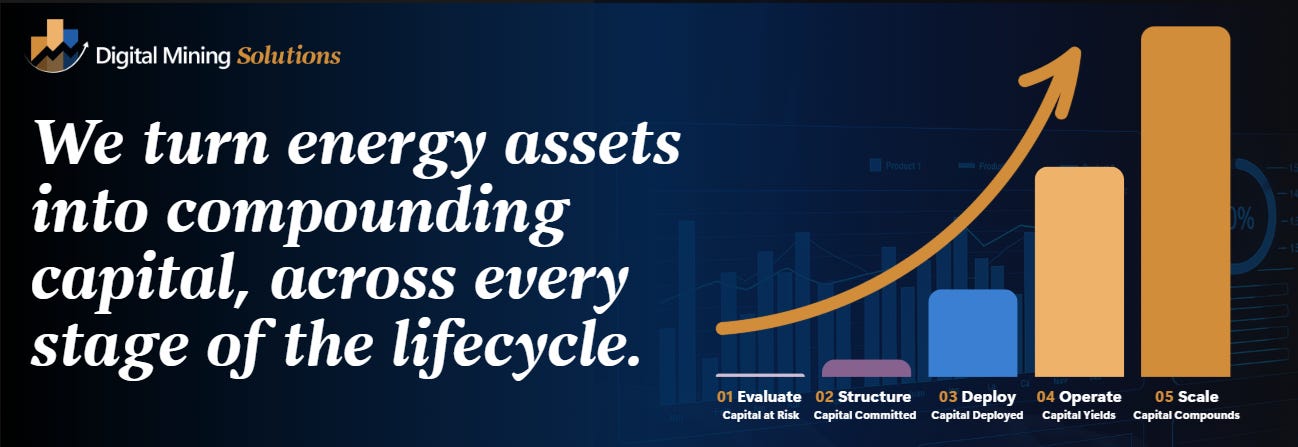
The difference between a well-structured infrastructure investment and a poorly executed one isn’t the thesis. It’s the underwriting, the deal structure, and the people running the project.
Digital Mining Solutions advises investors deploying $5M–$100M into energy-backed digital infrastructure: Bitcoin mining, AI compute, and hybrid energy assets. We cover the full lifecycle: evaluating opportunities before the term sheet, structuring deals that protect the downside, and staying engaged through deployment and operations to make sure capital performs as modelled.
We bring what most investors in this space lack: real operator relationships, a clear framework for underwriting infrastructure economics, and the credibility to sit across the table from developers and vendors on your behalf. Ready to deploy with confidence?
If you enjoy the content, if you have not subscribed, please ensure to click the button below and share The Bitcoin Mining Block Post.
If you want to stay ahead in the world of Bitcoin mining, make sure to follow me on Twitter and LinkedIn. Would you like to become a sponsor of the newsletter or are you interested in a workshop on mining economics? Contact me at nicosmid@digitalminingsolutions.tech.